The WaterBoss 700 water softener delivers excellent performance and efficiency, and needs very little salt and water to regenerate. There are no filters to replace – the system has a built-in self-cleaning filter.
Eco-friendly technology – less wastewater and lower energy use, because the softener regenerates only when it is really needed. Thanks to its compact size, the WaterBoss softener fits into the space you already have. The self-cleaning sediment filter saves you time and money – it never needs replacing.
The WaterBoss 700 softens and filters water for the whole house, using only 56 litres of water and just 2.5 kg of salt per regeneration.
- Maximum compensated hardness, gpg: 70 (1200 mg/l)
- Maximum iron reduction, ppm*: 10
- Minimum pH, standard units: 7
- Water and ambient temperature, min–max: 40°–120°F (4°–49°C)
- Controller type: 4-button, icon-based
- Electrical rating: 12V AC, 50/60 Hz, 0.015 kWh
- Approximate shipping weight: 85 lb (39 kg)
- Dimensions: 38 × 48 × 65 cm (width, depth, height)
WaterBoss 700 advantages:
- Filters and softens water for the whole house
- Removes dirt and sediment down to 20 microns
- Reduces iron by up to 10 ppm
- Softens water with hardness up to 1200 mg/l (70 gpg)
- Regenerates in just 18 minutes
- Uses only 56 litres of water and 2.5 kg of salt per regeneration
- Built-in self-cleaning filter – no filter replacement needed
- Effectively solves most well-water problems
- Made in the USA
Regeneration is an essential stage of the water softening process and the reason your system needs salt from time to time. When the softener reaches its capacity for the hardness minerals in the water, it rinses and cleans the resin with a salt solution called brine. Once the cycle is complete, the softener is ready to remove hardness again.
Guaranteed quality: every unit is tested
The WaterBoss 700 is designed for optimal performance and efficiency, so it needs the minimum amount of salt and water to complete a regeneration.
WaterBoss softeners are among the few systems on the market that use fine-mesh resin – a spherical resin with a larger surface area than the resin used in competing models. This reduces water, salt and electricity consumption for optimal, smart efficiency. Every softener model also has a built-in self-cleaning dirt and sediment filter that saves you time and money.
IRON REMOVAL
Iron removal results depend on factors such as water temperature, pH, alkalinity, dissolved oxygen and others. The right iron removal method also depends on the type of iron in your water.
Before choosing any water treatment system, it is important to have your water tested – especially for iron removal. The WaterBoss® 700 removes iron by ion exchange and can remove up to 10 ppm of iron from water.
Most conventional softeners can remove 1–3 ppm of iron from the supply water. Thanks to its compact bed of fine-mesh resin, WaterBoss can remove more, and it can remove iron at higher pressure.
- WaterBoss is the only unit with a separate built-in self-cleaning dirt and sediment filter for the whole-house water supply.
- A patented directional-flow screen system lets WaterBoss use the entire tank space for resin – which means more softening power.
- The low, easy-to-fill salt compartment saves effort.
- WaterBoss cuts running costs: it uses up to 50% less salt and up to 80% less water per regeneration than conventional softeners. It also runs on 12 volts, while other softeners use at least 24 volts.
- WaterBoss can regenerate in just 18 minutes, while conventional softeners can take almost two hours.
- The controller is easy to set up: press one button, enter the setting number and the computer does the rest.
- Guests coming or going on holiday? No need to change the settings – the computer adapts automatically.
- WaterBoss looks as good as it performs – you can feel the quality. It also takes up much less space than conventional softeners.
- WaterBoss has a safety shut-off whose only job is to prevent overfilling. Other softeners use float systems to control how much water enters the brine tank; on WaterBoss the brine refill is set by the controller, and the shut-off is only there to stop the brine tank from overflowing.
- WaterBoss has a filled resin bed with reserve capacity, which also lets it regenerate with clean, soft water.
WaterBoss has been making and offering the best solutions for controlling the water in your home for more than 30 years. With these water softeners and filters, you can be sure you have chosen the best and safest solution for your family and home.
Reliable products
WaterBoss makes water softeners of a unique, patent-protected design. The latest technology and high-quality materials are used to build energy-efficient, affordable systems. Every WaterBoss product is thoroughly tested before shipping to ensure reliability.
Technology you can trust
WaterBoss softeners are among the few systems on the market that use fine-mesh resin – a spherical resin with a larger surface area than the resin used in competing models. This reduces water, salt and electricity consumption for optimal, smart efficiency. Every softener model also has a built-in self-cleaning dirt and sediment filter that saves you time and money.
WATER HARDNESS UNIT CONVERSION
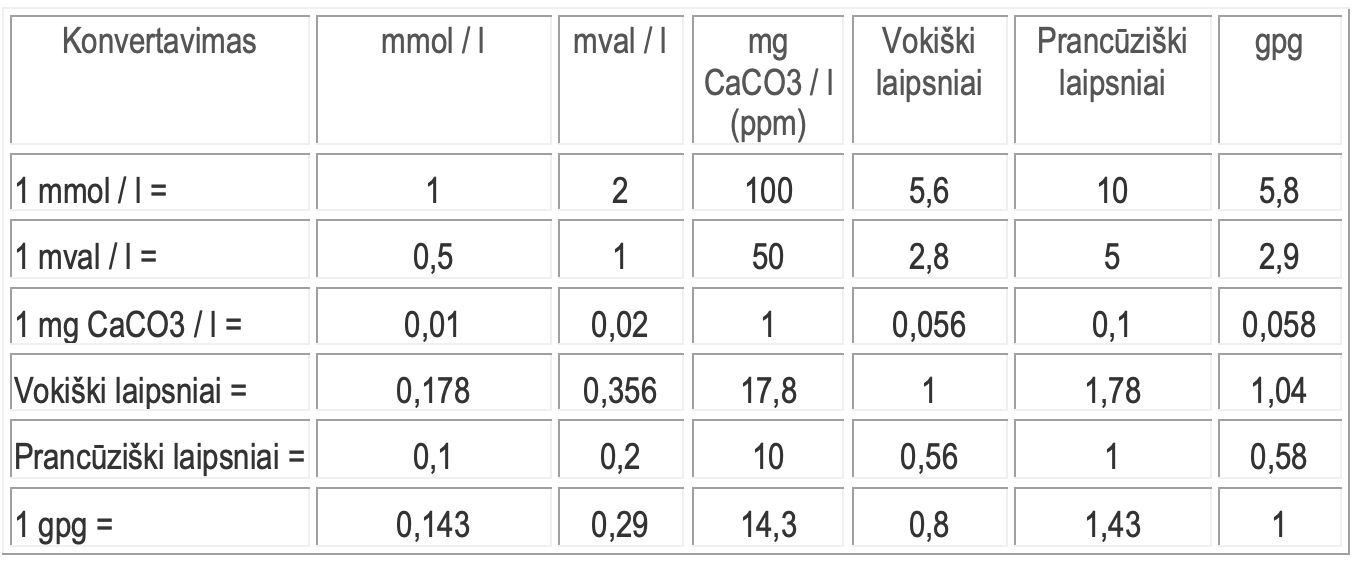
Water hardness is an indicator measured in specific units, most often showing the amount of Ca and Mg salts dissolved in water. It is expressed in mmol/l (millimoles per litre) or mg/l (milligrams per litre, CaCO3 equivalent).
Hardness levels
soft – 0–20 mg/l
fairly soft – 20–40 mg/l
slightly hard – 40–60 mg/l
fairly hard – 60–80 mg/l
hard – 80–120 mg/l
very hard – >120 mg/l
Since water hardness can also be measured in other units, you can convert between them using the table below.
WATER SOFTENING
More than 60% of the water on Earth is groundwater, which, as it seeps deeper, becomes saturated with all kinds of minerals from the soil, including calcium and magnesium. The amount of these hardness minerals in water determines its "hardness". Water hardness is measured by the amount of dissolved Ca and Mg salts – mg-eq/l. Limit values of CaCO3 in water: soft water 0–1 mg-eq/l, very hard water >6 mg-eq/l.
Excess calcium and magnesium salts form limescale: white stains appear on sinks and bathtubs, and water flows very weakly from showers and taps because of scaling. Water softening helps reduce the concentration of calcium and magnesium ions in water.
Households most often use softening filters consisting of a filter vessel filled with synthetic resin, called cation exchange resin, and a salt tank. Hard water passes through the resin, which retains the hardness minerals in the water – a so-called ion exchange reaction takes place. During this reaction, the calcium and magnesium ions in the water are replaced with sodium ions. After some time the resin becomes saturated and has to be renewed, as its exchange capacity runs out. This is done by the regeneration program – the resin is regenerated with a solution of common salt.
Regeneration consists of several cycles during which a special salt solution and water, flowing in different directions and at different speeds, rinse the media, and the accumulated hardness ions are flushed into the drain. Filters use special NaCl salt for regeneration, so the salt tank needs to be topped up from time to time.
Many people think that water from a softening filter cannot be consumed because it contains too much sodium. However, the average sodium content per litre of water after a softening filter is 60 to 90 mg, while a slice of white bread contains 120 mg of sodium.
If this is undesirable, drinking water filters working on the reverse osmosis principle can be installed in addition; they remove sodium from the water.
BENEFITS OF WATER SOFTENING
Soft water protects pipes and heating elements from limescale, which increases energy costs for heating water.
It helps protect taps from limescale so that they shine like new.
Your household appliances – washing machines, boilers, dishwashers and others – will last longer and need fewer descaling products.
A great feeling in the bath and shower. Soft water is ideal for sensitive skin. Spend less on skin care products and moisturisers.
Protect your glassware and tableware from limescale and save money by using fewer chemical descalers.
Your clothes will be cleaner and brighter, and fabrics softer. Save on soap and fabric softeners.
CONNECTION SIZES
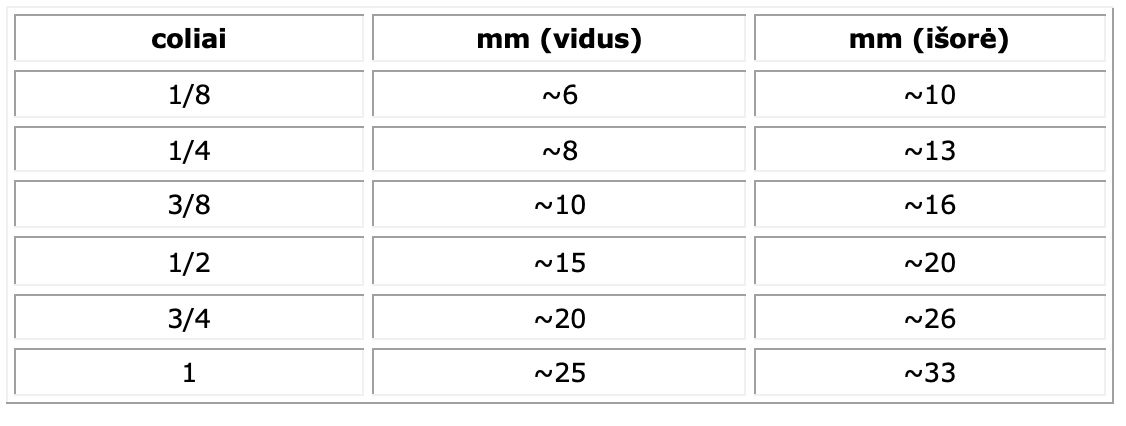
Connection sizes are usually given in inches, which can make it confusing to choose the right fittings, since we are used to metric units – in this case millimetres. The ratio of inches to millimetres for connections is approximately as follows; we recommend measuring with a caliper: