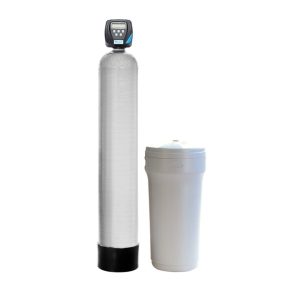
TECHNICAL SPECIFICATIONS
Media volume 42 L
Nominal capacity (m3/h) 0.8
Maximum capacity (m3/h) 1.3
Dimensions L x D x H mm 720 x 260 x 1600
Vessel size D x H (inches) 10 x 54
The pressure gauges, mechanical filters with housing, bronze fittings, check valves and tubing shown in the photo are not included in the kit; they can be purchased separately.
IRON IN WATER
Too much iron in water is a fairly common drinking water quality problem, both in mains water and in water from wells or boreholes. Iron not only gives water an unpleasant taste and a cloudy orange colour and leaves red or brown stains on plumbing fixtures, it is also harmful to health. Increased iron in water first of all damages appliances. Rust quickly coats pipes and settles in washing machines and dishwashers. Iron is also unsafe for health – regular use of such water can cause allergies, dry and irritated skin, and liver and kidney disease. That is why removing iron from water becomes a must to avoid serious health and technical problems. Iron removal filters are designed to remove solid particles, iron, hydrogen sulphide, manganese and mechanical impurities from water. Iron can be: 1) dissolved in water – the water runs clear but over time oxidises on contact with air and becomes cloudy, or 2) already oxidised in the water – the water runs brown from the tap.
Types of iron in water and its compounds: • ferric iron, which can be removed with mechanical depth filtration filters (filled with quartz, zeolite or other types of sand); • ferrous iron, which can be removed with iron removal and cation-exchange softening filters; • organic iron compounds, removed with filters containing anion-exchange media or a mixture of anion- and cation-exchange media. In this case not only is the iron removed, but the water is also softened.
Since there is currently no universal, cost-effective iron removal method, iron removal can be considered one of the most complex water treatment processes. Several water quality problems often need to be solved at the same time. A chemical water analysis is essential before installing iron removal equipment. Sometimes, with especially high contamination, pre-treatment equipment (a mechanical filter, dechlorination equipment or other filters) is required. Iron removal filters are most often used with private boreholes or when mains water is very high in iron. Only a thorough water analysis can show exactly what capacity iron removal filter you need and whether additional accessories are required.
TYPES OF FILTERS
REAGENT-FREE IRON REMOVAL FILTERS WITH AN OXIDATION TANK
This is one of the most modern water treatment technologies and it is becoming increasingly popular. The essence of this method is saturating water with oxygen. No additional reagents are used, so servicing such systems is very cheap. Such a system works by oxidising dissolved ferrous iron Fe+2 ions and converting them into insoluble ferric iron Fe+3 compounds. During this process, manganese and hydrogen sulphide, which causes an unpleasant water odour, are also oxidised and removed. Insoluble sediment is retained in the filter media, which is backwashed and regenerated at night. Such an iron removal unit usually consists of two vessels (columns), filter media, an electronic or electromechanical control valve and an air injection unit. Compressed air is injected into the water line before the filtration system and mixed with the iron-rich water. The water-air mixture enters the oxidation tank (the first column), where ferrous iron is converted into ferric iron through oxidation, forming iron hydroxide compounds (rust) (Fe+² → Fe+³). Most ferric iron compounds are insoluble and precipitate after oxidation. As the water flows through the filter media (in the second column), the ferric iron sediment and other solid particles in the water are retained. Once the filter has accumulated enough insoluble particles, the filter media is regenerated. Regeneration of the filter media is carried out at a chosen time when water consumption is lowest. During regeneration, the filter media is loosened and the retained particles are flushed into the drain.
AUTOMATIC MECHANICAL FILTER
The filter’s purpose is to collect mechanical particles in the water. As water flows through the filter media or a special filter bag/mesh of the required micron rating, it is filtered mechanically. The filter backwashes automatically according to the programmed backwash frequency.
REAGENT IRON REMOVAL FILTERS WITH STRONG OXIDANTS
These filters use sodium hypochlorite, potassium permanganate and sometimes ozone as oxidants. Reagent-based iron removal is used when the concentration of dissolved iron is very high or the pH is very low. Reagent filters require regular maintenance and are more expensive than reagent-free ones. The purpose of the filters is to capture dissolved ferrous iron and manganese in the water. This is done using special media whose surface is activated with a reagent solution. As the iron-rich water passes through the media, all the iron and manganese settle on its surface. The media is regenerated at night with a reagent solution prepared automatically. This iron removal technology should be used when the water has a yellowish tint, an unpleasant odour or a high manganese content.
ION EXCHANGE RESIN FILTER
One of the most common ways to remove iron from water is ion exchange. This type of unit works when the water contains non-oxidised iron, i.e. iron Fe² dissolved in water passes through the filter. The filter media “absorbs” the non-oxidised iron ions together with calcium and magnesium ions, and iron-free water flows from the outlet. The iron ions, together with other divalent metal ions, remain in the ion exchange resin. Manganese, strontium, barium and radium are removed from the water at the same time – this versatility is a major advantage of ion exchange systems. The capacity of the filter media is not unlimited, and it is periodically regenerated with a prepared salt solution. The salt solution comes from a tank and restores the resin’s filtering properties. The accumulated iron is released into the salt solution, which is then discharged to the drain. Such a system is not suitable if the water contains hydrogen sulphide.
IRON REMOVAL BY COAGULATION
This is a reagent method in which water is treated with coagulants – substances that make contaminant particles clump together and form flakes, which are then captured by filters. This method is used to remove organic iron when other oxidants do not help.
BIOLOGICAL FILTERS
Such filters are usually used at water treatment plants and start filtering water properly after 2–3 months, once suitable bacterial colonies have formed in them. There are many kinds: water treatment starts with iron bacteria that “catch” and oxidise iron, followed by nitrifying bacteria that “eat” ammonium ions and convert them into nitrates, and finally manganese-loving bacteria that remove manganese. Hydrogen sulphide is highly toxic to these bacteria, so it must be removed at the very start of treatment by strongly aerating the water. Such filters use the ability of certain microorganisms to clean water of impurities. Sometimes this turns out to be the only possible way to reduce iron in water – for example, when its concentration is very high or when the water contains a lot of hydrogen sulphide and carbon dioxide. Water passed through the biofilter is sorbed and disinfected with ultraviolet light.
REVERSE OSMOSIS FILTERS
Moderate iron concentrations can be removed by reverse osmosis, where water is forced under pressure through a special membrane that retains 95% to 99% of the substances dissolved in water. This method also requires no reagents. It is often used in low-capacity household filters, but treating large volumes this way is not economical. For apartments and small houses, however, it is almost ideal – the running costs of reverse osmosis systems are relatively low, although the membranes need regular replacement or chemical cleaning.
Systems for treating water with a high iron content vary, and it is hard to determine on your own which one is better – each is designed for specific conditions, so equipment selection is best left to specialists who will analyse the water and determine which filter is best to install.
Contact us about having a water sample analysed – the laboratory test result helps choose the right iron removal filter.