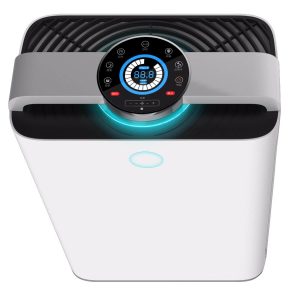
K08A air purifier for reducing indoor pollution.
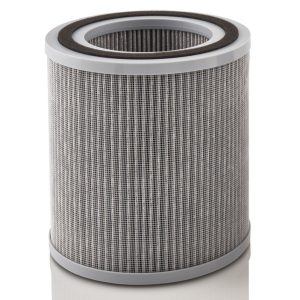
Filter replacement is recommended twice a year in cities and once a year in rural areas
Indoor pollutants:
Particulate matter PM2.5, formaldehyde, chemical compounds, kitchen fumes, dust, cigarette smoke, toilet odour, benzene, bacteria.
Three functions of the K08A air purifier:
1. Filters
Physical pollution, pollen, PM2.5 dust, smoke.
2. Removes
Chemical pollution, formaldehyde, benzene, toluene, TVOC.
3. Destroys
Biological pollution, bacteria, microbes, mould, fungi, dust mites.
Air purifier operating stages:
Six filters
1. Aluminium alloy filter
The aluminium alloy dust filter can filter coarse dust, dander, pollen and other pollutants.
Multi-layer pleated aluminium mesh with low initial resistance, high dust-holding capacity and durability.
Light weight, compact structure, easy to install.
Clean with compressed air so it can be cleaned and reused many times
Easy cooling can extend the life of the fan motor
2. Cold catalyst filter
Cold catalytic decomposition needs no UV rays, high temperature or high pressure. In a normal living environment it can have a catalytic effect to control pollution.
It can break down various harmful gases and catalyse formaldehyde, ammonia, benzene, TVOC, hydrogen sulphide and other harmful gases to react with oxygen in the air, producing water and carbon dioxide.
Long-lasting: if not damaged by external force, it remains effective for five years, with good long-term formaldehyde control.
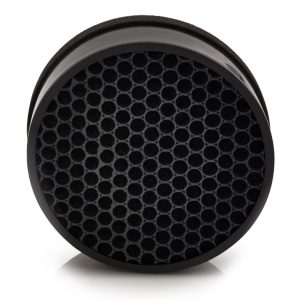
3. Honeycomb activated carbon filter
For environmental protection, a polypropylene honeycomb shell is used with a honeycomb cell structure filled with activated carbon pellets; the high carbon content compared with a traditional activated carbon filter gives better aerodynamic properties, high adsorption efficiency and a low wind resistance coefficient.
Activated carbon is an effective catalyst that greatly improves the ability to remove all kinds of harmful gases; it can adsorb formaldehyde, toluene, xylene, ammonia and other harmful substances, with a removal rate of 99% or more and a high saturated adsorption capacity.
The coconut shell activated carbon used has an iodine value of more than 900 (technical parameter), equal to a filtration area of 18 football pitches; carbon weight: 200 g ± 20 g.
4. Antibacterial cotton mesh
Uses fibrous non-woven material imported from the United States, which is antibacterial, moisture-resistant and mould-resistant; bacteria find it hard to multiply on it.
Destroys bacterial cell walls: the cell membranes rupture, the cytoplasm leaks out and microbial metabolism stops, giving an effective removal effect.
5. HEPA filter
The HEPA filter can filter tiny particles larger than 20 nanometres, including bacterial mould, dust, allergens and some viruses. World Health Organization publications show that bird flu, human flu and legionella bacteria are larger than 20 nanometres.
Filtration accuracy 99.9%, filter opening 0.01 µm. The HEPA filter is a new type of highly purified material that needs no energy at room temperature; it can filter 99.97% of dust, achieve a sterilisation rate of 99.99% and an adsorption rate of 99.97% for dust (smoke, dust, etc.) of 0.1 micron or larger; it can effectively destroy fungi and also has a strong inhibitory effect on bacteria.
The unfolded area is 1.21 square metres and the length is 4.3 metres.
6. Ultraviolet sterilisation
UVA wavelength 320–400 nm. When bacteria absorb UV, the DNA chain breaks, nucleic acid and protein cross-links break down, the nucleic acid loses its biological activity and the bacteria die.
Light with a wavelength of 365 nm is used for sterilisation
7. Anion release
Negative ion generator principle: the 220 V input is converted by the oscillator circuit into a high-frequency high-voltage charge, and the boost circuit converts it into high-frequency high-voltage DC 20 kV, creating an 80–100 m emission.
Removes dust and static electricity.
Helps make the air feel fresher.
Product photos may differ from the actual appearance of the products, but their properties and technical specifications will not differ from the description. Products in the shop may also differ in colour, shape or other parameters from their actual size, shape and colour due to the characteristics of the Buyer’s display.