


The membrane is ideal for systems with 50 GPD membranes. Increases water flow.
TECHNICAL SPECIFICATIONS
Capacity: up to 284 litres per day
Dimensions: 340x340x360
Filtration rate: up to 99%
For all standard reverse osmosis systems (household and aquarium).
An original US product, especially valued by aquarium enthusiasts for its excellent design, high capacity, long service life and ideal water parameters. The membrane is suitable for RO4, RO5, RO6 and RO7 reverse osmosis systems and all standard Aquarius-type filters.
OPERATING CONDITIONS:
– water temperature: 4–45 °C
– maximum salinity: 2,000 ppm
– maximum water hardness: 400 mg CaCO3
– maximum water turbidity: 1 NTU
– feed water pH range: 3–11 pH
– chlorine in raw water: < 0.1 ppm
– maximum iron and manganese: < 0.05 ppm
The membranes are tested and certified by NSF International to NSF/ANSI 58
RO MEMBRANE
An extremely fine-pored filter (pore size 0.0001 micron) working on the reverse osmosis principle. When pure water and a salt solution are separated by a semi-permeable membrane that lets only water molecules through, the pressure (concentration) difference on the two sides of the membrane makes water molecules pass to the salt solution side. This continues until the salt concentration on both sides is equal. This process is called direct osmosis. When highly mineralised water is treated with a reverse osmosis membrane, pressure exceeding the osmotic pressure is applied and the water molecules are forced through the membrane in the direction opposite to direct osmosis, i.e. from the highly mineralised water into the pure water compartment. The membrane pores are much smaller than viruses and bacteria, so these are removed during filtration. Heavy metals, dissolved substances and salts are removed as well.
The main parameter that defines a membrane’s characteristics is its capacity. Capacity is usually measured in GPD (gallons per day). It shows how much water the membrane can purify per day. 1 gallon = 3.78 litres (so if a membrane’s capacity is 100 GPD, up to 378 litres of water can be purified per day).
Water entering the membrane is separated into two streams: purified water and highly saline (concentrated) water, which contains all the separated salts and contaminants. Drinking water is supplied to the faucet or stored in pressure tanks until needed. The concentrate is discharged to the drain. The ratio of drinking water to concentrate can vary (from 1:1 to 1:7) and depends on the quality and pressure of the water supplied to the reverse osmosis system and on the system’s features, such as whether it has a pump.
The membrane is replaced every 24–84 months or as needed, depending on water consumption and the membrane’s capacity.
HOW TEMPERATURE AFFECTS RO WATER PRODUCTION
A lot of money is wasted on replacing membranes unnecessarily because the effect of water temperature on reverse osmosis (RO) system performance is overlooked. When the water flow drops, it is usually assumed that the membrane is fouled, while in fact the feed water temperature has simply dropped, significantly reducing membrane output. This often happens because the lower feed water temperature in winter is forgotten. RO system manufacturers get calls from customers: “For some reason the system produces 30–50% less water than before, although the feed water conditions have not changed.” Such a conclusion ignores temperature.
FACT: When water is colder, it is “thicker” and the flow rate from the membrane decreases. As water warms up, it becomes “thinner” and the flow rate from the membrane increases. All flow rates given in reverse osmosis system and membrane specifications are calculated at a water temperature of 25 ℃. As the water temperature changes, so does the flow rate, because warmer water is less viscous and diffuses faster, making it easier for it to pass through the RO membrane.
Temperature correction factor. Temperature affects the product flow through the membrane: high temperature increases the product flow, low temperature decreases it. To determine the membrane flow rate at a different temperature (not 25 ℃), multiply the RO membrane flow given in the specification by the temperature correction factor shown in the table. The result is the product flow at that temperature.
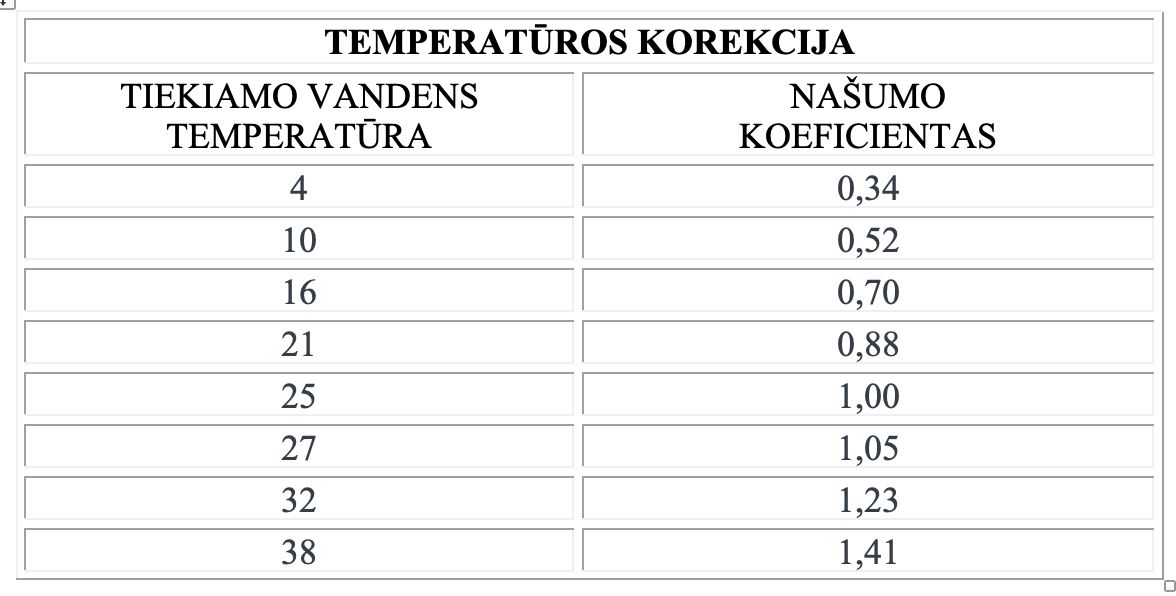
Example: a 100 GPD membrane flow rate at 25 ℃, 65 PSI (4.4 ATM) = 378 litres per day. What is the product flow at 10 ℃?
Answer: use the temperature correction factor (from the table) = 0.52.
The new product flow at 10 ℃ is 378 x 0.52 = 196 litres per day.
Feeding water from a water heater into an RO unit to raise the water temperature is not recommended. Water above 38 ℃ most often damages standard RO membranes, and the tanks of all water heaters contain contaminants and sediment that can damage the membrane and the RO unit.
When replacing the reverse osmosis membrane, we recommend also replacing the flow restrictor so that the membrane works optimally.
Here are a few examples:
– A 300–350 cc flow restrictor suits a 50 or 75 GPD membrane.
– For a 100 GPD membrane, a 420–450 cc flow restrictor is better.
– For a 150 GPD membrane, a 550–700 cc flow restrictor can be used.
A correctly chosen flow restrictor helps ensure efficient membrane operation.
Analysis of the most common membrane problems
1. Equalisation of osmotic pressure (for RO systems with pumps)
– When a membrane is not used for a long time, the osmotic pressure on both sides of the membrane can equalise. This means there is not enough pressure difference, which is essential for effective water filtration. As a result, the filtration process becomes less effective and the total dissolved solids (TDS) level in the purified water can increase.
Solution:
When starting to use the system after a longer idle period, it is recommended to run a certain amount of water through the membrane. This helps restore the pressure difference and flush out substances that may have accumulated while the system was idle.
2. Membrane fouling
Long periods without use can lead to fouling of the membrane surface, as accumulated substances can stick to the membrane and reduce its permeability and efficiency.
Solution:
Regular use of the system helps maintain a constant pressure difference and reduces the risk of membrane fouling.
It is important to regularly check and replace the pre-filters that protect the membrane from larger particles. This extends the membrane’s service life and ensures effective filtration.
Checking membrane quality
Use a TDS meter to monitor the quality of the purified water. If the TDS level starts to rise, this may mean that the membrane’s efficiency has decreased and it needs to be replaced.
3. Soft water (after softening filters)
If your osmosis system is installed after a water softener, the membrane’s efficiency and service life can increase several times. The water softener removes hardness minerals such as calcium and magnesium compounds, which over time can clog the membrane and reduce its permeability. With the reduced load on the membrane, the system works more efficiently and the membrane needs replacing much less often.
Product photos may differ from the actual appearance of the products, but their properties and technical specifications will not differ from the description. Products in the shop may also differ in colour, shape or other parameters from their actual size, shape and colour due to the characteristics of the Buyer’s display.


