


ZEROWATER Premium 5-stage filtration
Removes 99.6% of total dissolved solids, including lead

Delivers the purest-tasting water

Certified – reduces lead


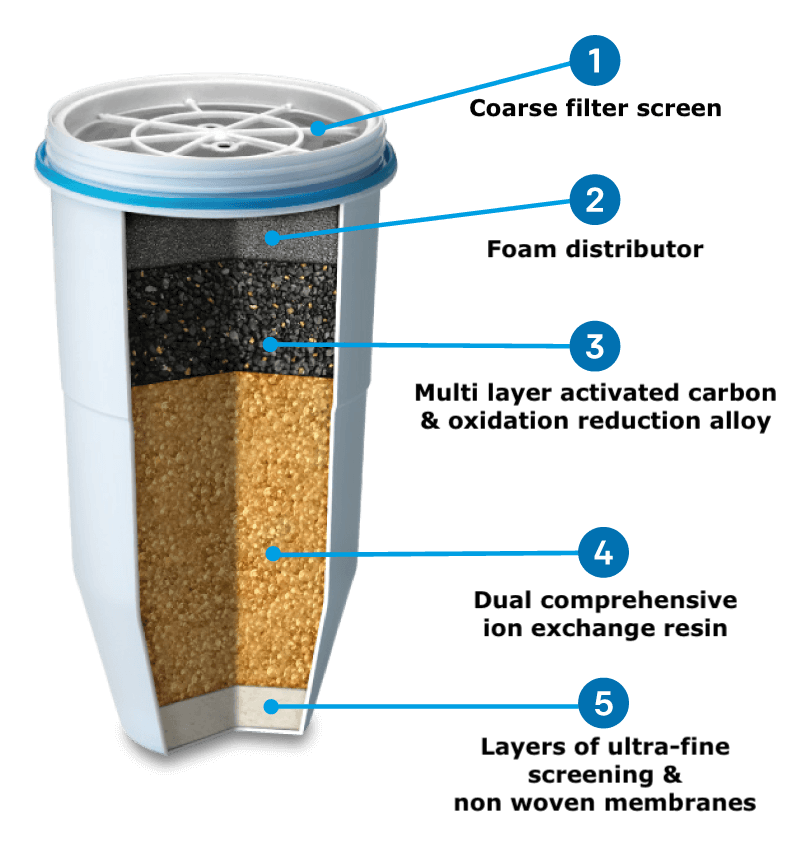
HOW DOES THE WATER FILTER WORK? By filtering out all dissolved substances from water, you get pure water. |
THE ZEROWATER FILTER CONTAINS: |
|
STAGE 1 (coarse filter) Filters fine particles and sediment. STAGE 2 (distributor) STAGE 3 (multi-layer system: activated carbon and oxidation reduction alloy) STAGE 4 (dual ION EXCHANGE system) STAGE 5 (ultra-fine filter and non-woven membrane layers) |
WHAT IS TDS?
TOTAL DISSOLVED SOLIDS
A measure of dissolved solids such as minerals, salts and organic compounds that dissolve in water on contact with rocks and other surfaces. TDS can consist of several different types of compounds (including but not limited to): calcium, magnesium, iron, sodium chloride and sulphides (often found in tap water).
*An increased TDS (total dissolved solids) level can affect the taste and appearance of your water.

Total dissolved solids (TDS) are minerals, salts, metals including lead, chemicals, fluoride and more that contaminate drinking water.
ZeroWater Technology is the only water filtration system that removes 99.6% of dissolved solids, matching the TDS of purified bottled water.
Below is a comparison of the five-stage ZeroWater filter with a conventional inorganic chemical filter, based on the EPA (Environmental Protection Agency) primary drinking water standards and contaminants under the EPA secondary drinking water standards. The results are based on filtering 150 litres of water, twice the nominal capacity, to ensure consumer safety.
| METALS | ||
|---|---|---|
| CONTAMINANTS | ZEROWATER FILTERS | BRITA MAXTRA |
| AVERAGE ZEROWATER REDUCTION 95% | AVERAGE BRITA REDUCTION 68% | |
| Antimony | 97% | 91% |
| Arsenic (+3) | 83% | 0% |
| Arsenic (+5) | 93% | 41% |
| Asbestos | 97% | 8% |
| Barium | 98% | 88% |
| Beryllium | 97% | 70% |
| Cadmium | 99.9% | 79% |
| Chromium 3 | 81% | 47% |
| Chromium 6 | 99.9% | 23% |
| Copper | 99% | 99% |
| Cobalt | 99% | 95% |
| Iron | 98% | 99% |
| Lead | 97% | 80% |
| Manganese | 98% | 52% |
| Mercury | 96% | 92% |
| Selenium | 98% | 0% |
| Silver | 81% | 52% |
| Thallium | 99% | 93% |
| Uranium | 99% | 90% |
| Zinc | 98% | 99% |
| INORGANICS | ||
|---|---|---|
| CONTAMINANTS | ZEROWATER FILTERS | BRITA MAXTRA |
| AVERAGE ZEROWATER REDUCTION 68% | AVERAGE BRITA REDUCTION 33% | |
| Chlorine | 95% | 95% |
| Cyanide | 31% | 0% |
| Fluoride | 41% | 17% |
| Nitrates | 74% | 0% |
| Nitrites | 81% | 28% |
| Beryllium | 55% | 81% |
HOW ARE ZEROWATER FILTERS TESTED?The results of tests carried out in an independent laboratory are based on the NSF/ANSI test protocols for contaminant reduction by filtration devices, as listed in the National Primary Drinking Water Standards. Contaminants were tested at the average influent challenge concentration set in the test protocols for the different contaminant types. The results were obtained after filtering 150 litres, twice the intended capacity, to ensure consumer safety. These results are calculated as the average of two pH levels (6.5 pH and 8.5 pH). * Indicates the contaminant reduction percentages for the ZeroWater filter established in the NSF certificate. These results are calculated as the average of two pH levels (6.5 pH and 8.5 pH). The test was carried out by Quality Filter Testing Laboratory, LLC, an independent ISO 17025 laboratory certified by WQA and IAPMO that tests water filters to NSF/ANSI 42, 53, 58, 401, 473 and P231 standards. The test results are based on NSF/ANSI standards for filtration devices, as performed by Quality Filter Testing Laboratory, LLC, an IAPMO-recognised independent ISO 17025 laboratory located in Williamstown, New Jersey. The ZeroWater 5-stage filter with a rated capacity of 75 litres and the 2-stage standard Brita filter with a rated capacity of 150 litres were tested. The tests were carried out at the manufacturers’ recommended daily rate, filtering 7.5 litres of water per day. The results shown are the average of each filter’s test results at water pH levels of 6.5 and 8.5. Brita® is a registered trademark of Brita®, L.P., which is not affiliated with Zero Technologies, LLC.Preparation of test waterFor the metal reduction test, water was prepared by adding the required amount of reagents to 20 litres of water to reach the concentration set in NSF/ANSI 42 and 53 for each metal. Metals not included in the NSF/ANSI standard were prepared at 10 times the concentration of the EPA drinking water standard limit for that metal. The test water was poured into both filters at the same time, 1 litre at a time over 45 minutes, followed by a 45-minute rest. After 20 litres had been passed through, filtered water samples were taken from each filter and tested for each metal using EPA method 200.8, except iron, for which method SM 3111-B was used. The pH of all contaminants was adjusted to 6.5 and 8.5, and the average of both results is given for each metal. Water for testing inorganic and non-metal parameters was prepared by adding the required amount of reagent to 20 litres of water to reach the concentration specified in NSF/ANSI 42 and 53 for each parameter, except for parameters not included in the NSF/ANSI standard. These were prepared at 10 times the concentration of the EPA drinking water standard limit for that parameter. The test water was poured into both filters at the same time, 1 litre at a time, with 45-minute load/45-minute rest intervals. After 20 litres had been passed through, a filtered water sample was taken from each filter and each parameter was tested along with the test water, using the appropriate EPA method or Standard Method for the Examination of Water.Summary:The compounds tested are those that the EPA lists as primary and secondary drinking water contaminants. The tested compounds are also listed in NSF/ANSI 53 and 42, which also set out procedures for contaminant reduction claims by filter manufacturers. The procedure used in this comparison test was based on the 2018 editions of NSF/ANSI 42 and 53. The analytical methods used in this test are EPA-approved methods for testing drinking water.
NSF – founded in 1944 as the National Sanitation Foundation – changed its name to NSF International in 1990, expanding its services beyond sanitation and into global markets. The letters in the organisation’s name no longer stand for specific words. Manufacturers, regulators and consumers look to NSF International to develop public health standards and certification programmes that help protect the world’s food, water, consumer products and environment. NSF International’s mission is to protect and improve human health worldwide. As an independent, accredited organisation, it facilitates standards development, and its service groups test and certify products and systems and provide auditing and risk management solutions for public health and the environment.


