


WHEN BUYING THIS PRODUCT, YOU CAN ALSO CHOOSE REPLACEMENT FILTERS AND A MEMBRANE.
Filter life: PP ~3–6 months; GAC ~8–12 months; CTO ~8–12 months; membrane ~10–12 months.
CONNECTION PARAMETERS
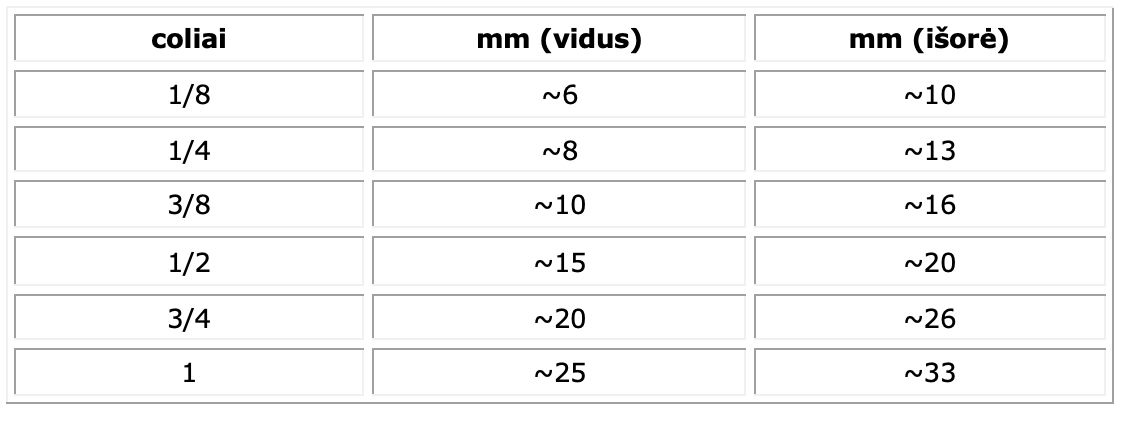
Connection sizes are usually given in inches, which causes confusion about which fittings to choose, as we are used to metric units – in this case millimetres. The ratio of inches to millimetres for fittings is roughly as follows; measuring with a caliper is recommended:
INSTALLATION ACCESSORIES
You will receive a fully working system, ready to connect to the water supply. All equipment can be installed by yourself without affecting the warranty. The kit includes all the parts and accessories needed to connect the system.
FILTRATION STAGES
Stage 1 – 5 micron PP filter
Stage 2 – granular activated carbon filter GAC
Stage 3 – 5 micron PP filter
Stage 4 – UF membrane
Stage 5 – activated carbon block filter CTO
FILTERS AND CARTRIDGES
PP 5 MICRON FILTER
A mechanical filter whose function is to physically remove sediment, dirt and any particles using a barrier. This filter removes particles larger than 5 microns. PP filters are made of multi-layer microscopic polypropylene fibre. Thanks to the pore structure of the fibre, dirt is retained.
GAC FILTER
A granular activated carbon filter made from coconut shell carbon. It removes organic substances, chlorine, odour and turbidity, as well as chemicals that give water an unpleasant taste. The filter is replaced every 6–18 months or as needed.
UF MEMBRANE
An ultrafiltration membrane can separate impurities with particle sizes from 0.001 to 0.1 microns – it retains viruses, bacteria and other impurities but leaves some trace elements.
MEMBRANE FILTRATION
Membrane filtration means removing substances from water using differences in particle size and pressure. The required separation can be achieved using a membrane (a semi-permeable material) with the following pore sizes:
– microfiltration (MF): pore size 10 to 100 nm (required pressure 0.1–2.5 bar) – removes only undissolved particles;
– ultrafiltration (UF): pore size 100 nm to 10 nm (required pressure 0.5–2.5 bar) – removes both undissolved particles and high-molecular-weight substances;
– nanofiltration (NF): pore size <10–1 nm (required pressure 5–15 bar) – removes micro-pollutants and multivalent ions (dissolved substances);
– reverse osmosis (RO, hyperfiltration): pore size <1 nm (required pressure 10–70 bar) – removes micro-pollutants and multivalent and monovalent ions (dissolved substances).
Membranes are used to treat both groundwater and surface water. When designing and ensuring optimal operation of the unit, the following must be considered:
– choosing the right membrane for the source water quality and the quality you want to achieve;
– the possible need for additional treatment before and after filtration;
– the membrane cleaning method (cleaning frequency, chemicals, etc.);
– the use of chemicals to prevent fouling (including biological), etc.

CTO FILTER
A carbon block filter made of monolithic activated carbon, which removes all organic substances, chlorine, odour and turbidity. Compared with a granular carbon filter, a carbon block has a much larger surface area and more active sites, so it is up to 25% more efficient than other types of carbon cartridges. It also filters mechanical impurities. Carbon cartridges are especially recommended for treating surface water.
A carbon block is a relatively new technology that uses activated carbon.
A carbon block has a solid monolithic structure and is technologically more advanced than traditional loose-media filters.
A carbon block is usually made from activated carbon powder mixed with ground polyethylene and sintered: fine carbon particles (20 to 50 microns) are “bonded” together by heat.
This produces an orderly sorption (absorption) medium whose properties, such as porosity, can be controlled during manufacturing. In addition, these properties remain constant throughout the service life.
Because the sorbent particles are bonded together, carbon blocks have practically no channelling effect, which is typical of ordinary loose-media filters.
FILTER MAINTENANCE AND REPLACEMENT INTERVALS
For the unit to work optimally, it needs regular maintenance. How often maintenance is needed depends on the feed water quality, how often the system is used and the amount of water filtered. The filter replacement intervals given for the filter are indicative. Remember that filter replacement frequency may vary, so we recommend monitoring changes in TDS in the purified water (measuring it at regular intervals with a TDS meter). If the TDS level changes significantly, replace the filters.
SINGLE WATER FAUCET
A single-flow faucet mounted on the countertop or the edge of the sink, through which the filtered water flows.
Water faucet model GF-02S
Water connections 1/2
PRESSURE GAUGE
Shows inlet water pressure.
WARRANTY TERMS
24 months for personal use
12 months for commercial use


