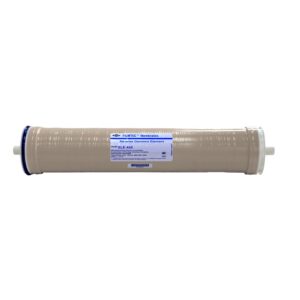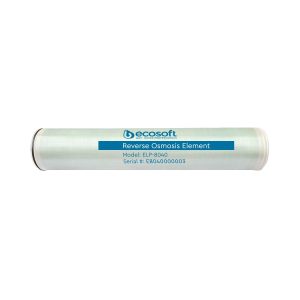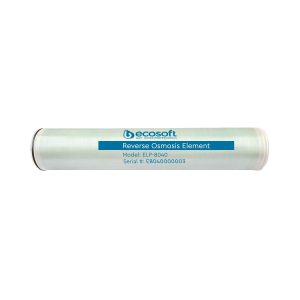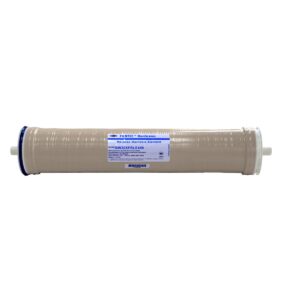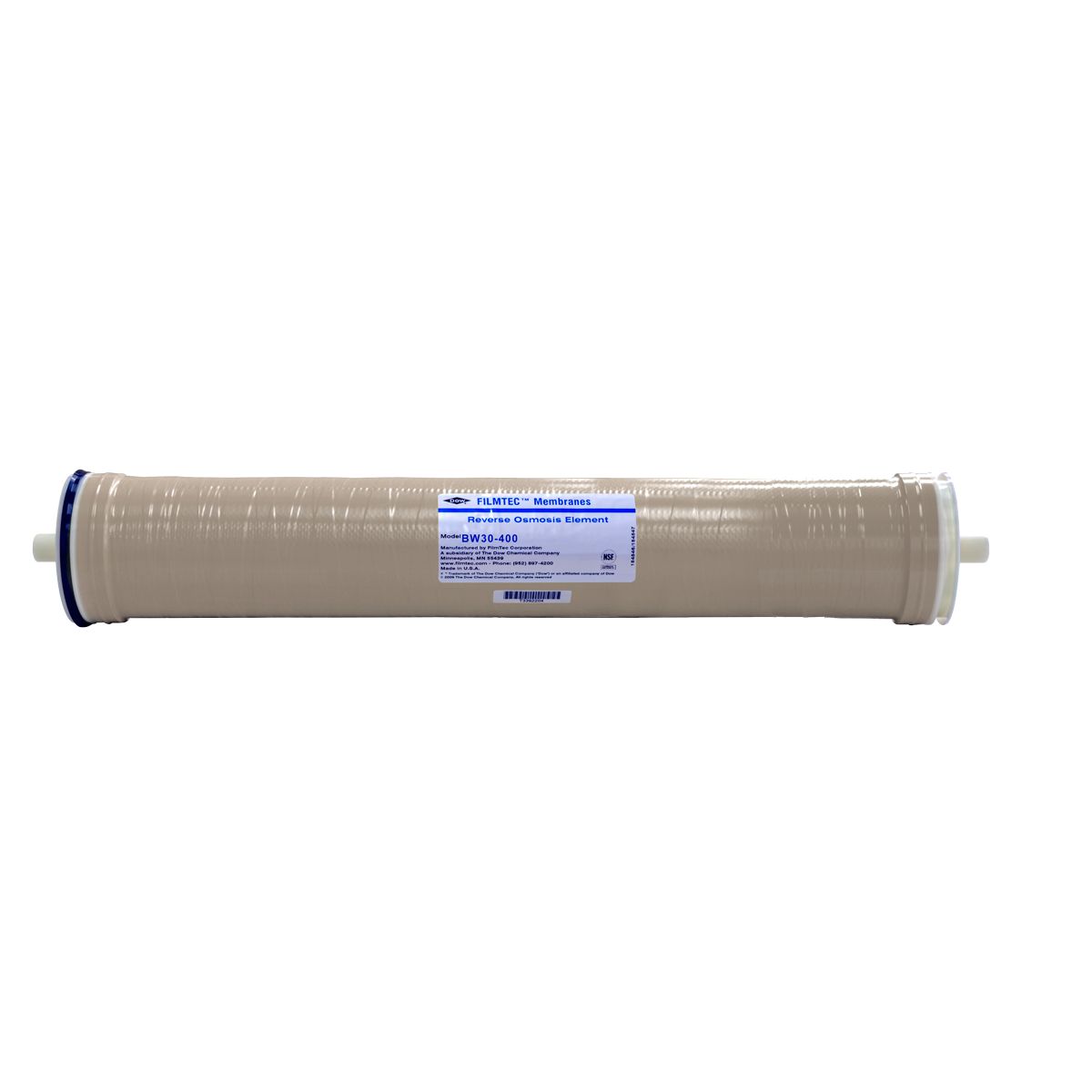
KEY FEATURES
- Ensures consistent water quality and higher rejection and flow compared with the previous-generation BW30 product.
- Built on the legendary BW30 – the industry-standard RO membrane with decades of proven performance.
- Excellent durability for stable, long-term performance.
SPECIFICATIONS
Main applications
- Industrial demineralisation, e.g. power generation, steel and metal industry, chemical and petrochemical industry.
- Municipal water treatment.
Typical properties
- Nominal active surface – 37 m²
- Permeate flow – 42 m³/day
- Stabilised salt rejection – 99.6%
- Minimum salt rejection – 99.4%
Notes
- Permeate flow and salt rejection are based on standard conditions: 2,000 ppm NaCl, 225 psi (15.5 bar), 77 °F (25 °C), pH 8 and 15% recovery.
- Flows of individual elements may vary but will not be more than 15% below the stated value.
- Sales specifications may change due to design updates.
Recommended operating conditions
- Membrane type – polyamide thin-film composite (TFC)
- Maximum operating temperature – 45 °C¹
- Maximum operating pressure – 41 bar
- Maximum pressure drop – 1.0 bar¹
- pH range (continuous operation) – 2–11¹
- pH range (short-term cleaning = 30 min) – 1–13²
- Maximum feed flow – 17 m³/h
- Maximum feed silt density index – SDI 5
- Free chlorine tolerance⁴ – <0.1 ppm
¹ The maximum temperature for continuous operation at pH > 10 is 35 °C.
² See the FilmTec™ cleaning guidelines (Form No. 45-D01696-en).
³ For recommended feed and permeate flows, flux and recovery for different water sources, see the FilmTec™ design guidelines for multi-element 8-inch systems (Form No. 45-D01695-en).
⁴ Oxidation damage is not covered by the warranty. DuPont recommends removing residual free chlorine by pretreatment before the water contacts the membrane. More: “Dechlorinating Feedwater” (Form No. 45-D01569-en).
General information
- After initial wetting, always keep the elements moist.
- For successful operation of reverse osmosis (RO) and nanofiltration (NF) membrane systems, the guidelines in the “FilmTec™ Reverse Osmosis / Nanofiltration Elements Operation Excellence and Limiting Conditions Tech Fact” (Form No. 45-D04388-en) must be followed.
- To prevent biological growth during long system downtimes, it is recommended to immerse the membrane elements in a preservation solution.
- The customer is fully responsible for the effects of incompatible chemicals and lubricants on the elements.
- Always avoid static back-pressure on the permeate side.
- Permeate produced during the first hour of operation must be discarded (drained).
- Using this product alone does not necessarily guarantee the removal of cysts and pathogens from water. Effective reduction depends on the overall system design, operation and maintenance.