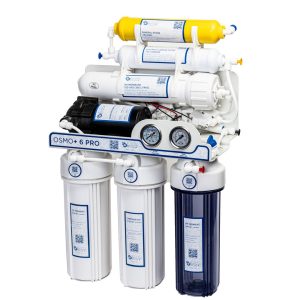
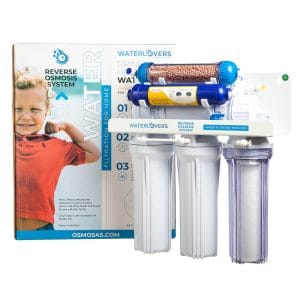
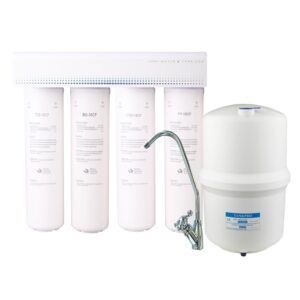
The RO6 SLIM reverse osmosis system has water pre-filtration cartridges – a C2IP sediment cartridge, which removes rust, sand and solid particles, and two C2ICB carbon cartridges, which remove chlorine, organic matter and some pesticides. The reverse osmosis membrane removes up to 99% of all contaminants larger than 0.001 µm and some viruses and bacteria.
The six-stage RO system also has a C2ICB inline cartridge, which further improves the taste and smell of water, and a C2IM mineralising cartridge, which enriches water with elements the human body needs.
CONNECTION PARAMETERS
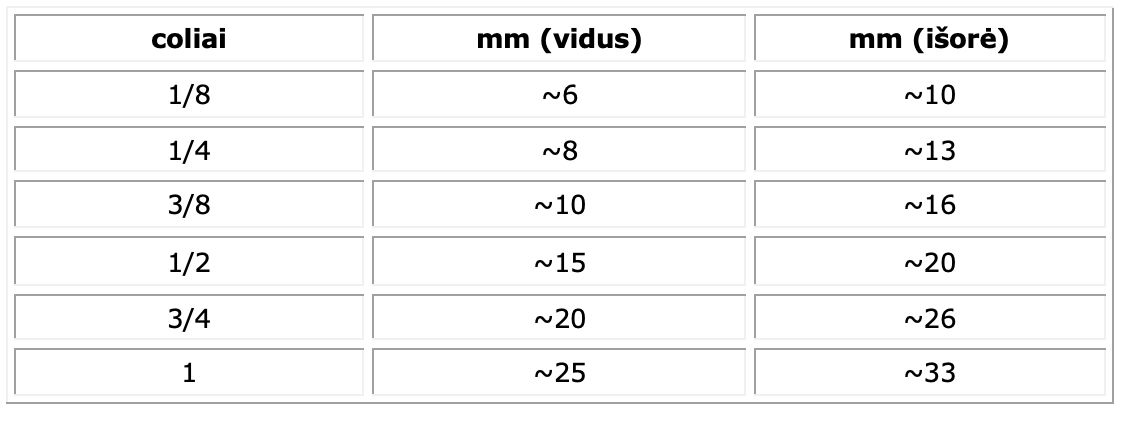
Connection sizes are usually given in inches, which causes confusion about which fittings to choose, as we are used to metric units – in this case millimetres. The ratio of inches to millimetres for fittings is roughly as follows; measuring with a caliper is recommended:
INSTALLATION ACCESSORIES
You will receive a fully working system, ready to connect to the water supply. All equipment can be installed by yourself without affecting the warranty. The kit includes all the parts and accessories needed to connect the system.
RO MEMBRANE
An extremely fine-pored filter (pore size 0.0001 micron) working on the reverse osmosis principle. When pure water and a salt solution are separated by a semi-permeable membrane that lets only water molecules through, the pressure (concentration) difference on the two sides of the membrane makes water molecules pass to the salt solution side. This continues until the salt concentration on both sides is equal. This process is called direct osmosis. When highly mineralised water is treated with a reverse osmosis membrane, pressure exceeding the osmotic pressure is applied and the water molecules are forced through the membrane in the direction opposite to direct osmosis, i.e. from the highly mineralised water into the pure water compartment. The membrane pores are much smaller than viruses and bacteria, so these are removed during filtration. Heavy metals, dissolved substances and salts are removed as well.
The main parameter that defines a membrane’s characteristics is its capacity. Capacity is usually measured in GPD (gallons per day). It shows how much water the membrane can purify per day. 1 gallon = 3.78 litres (so if a membrane’s capacity is 100 GPD, up to 378 litres of water can be purified per day).
Water entering the membrane is separated into two streams: purified water and highly saline (concentrated) water, which contains all the separated salts and contaminants. Drinking water is supplied to the faucet or stored in pressure tanks until needed. The concentrate is discharged to the drain. The ratio of drinking water to concentrate can vary (from 1:1 to 1:7) and depends on the quality and pressure of the water supplied to the reverse osmosis system and on the system’s features, such as whether it has a pump.
The membrane is replaced every 24–84 months or as needed, depending on water consumption and the membrane’s capacity.
HOW TEMPERATURE AFFECTS RO WATER PRODUCTION
A lot of money is wasted on replacing membranes unnecessarily because the effect of water temperature on reverse osmosis (RO) system performance is overlooked. When the water flow drops, it is usually assumed that the membrane is fouled, while in fact the feed water temperature has simply dropped, significantly reducing membrane output. This often happens because the lower feed water temperature in winter is forgotten. RO system manufacturers get calls from customers: “For some reason the system produces 30–50% less water than before, although the feed water conditions have not changed.” Such a conclusion ignores temperature.
FACT: When water is colder, it is “thicker” and the flow rate from the membrane decreases. As water warms up, it becomes “thinner” and the flow rate from the membrane increases. All flow rates given in reverse osmosis system and membrane specifications are calculated at a water temperature of 25 ℃. As the water temperature changes, so does the flow rate, because warmer water is less viscous and diffuses faster, making it easier for it to pass through the RO membrane.
Temperature correction factor. Temperature affects the product flow through the membrane: high temperature increases the product flow, low temperature decreases it. To determine the membrane flow rate at a different temperature (not 25 ℃), multiply the RO membrane flow given in the specification by the temperature correction factor shown in the table. The result is the product flow at that temperature.
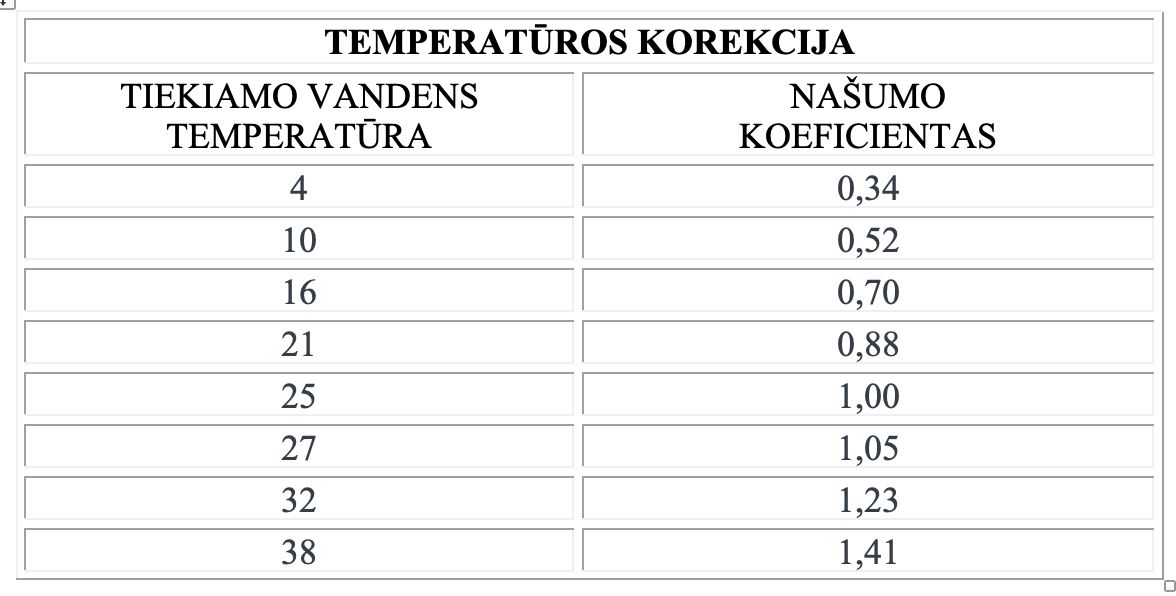
Example: a 100 GPD membrane flow rate at 25 ℃, 65 PSI (4.4 ATM) = 378 litres per day. What is the product flow at 10 ℃?
Answer: use the temperature correction factor (from the table) = 0.52.
The new product flow at 10 ℃ is 378 x 0.52 = 196 litres per day.
Feeding water from a water heater into an RO unit to raise the water temperature is not recommended. Water above 38 ℃ most often damages standard RO membranes, and the tanks of all water heaters contain contaminants and sediment that can damage the membrane and the RO unit.
When replacing the reverse osmosis membrane, we recommend also replacing the flow restrictor so that the membrane works optimally.
Here are a few examples:
– A 300–350 cc flow restrictor suits a 50 or 75 GPD membrane.
– For a 100 GPD membrane, a 420–450 cc flow restrictor is better.
– For a 150 GPD membrane, a 550–700 cc flow restrictor can be used.
A correctly chosen flow restrictor helps ensure efficient membrane operation.
Analysis of the most common membrane problems
1. Equalisation of osmotic pressure (for RO systems with pumps)
– When a membrane is not used for a long time, the osmotic pressure on both sides of the membrane can equalise. This means there is not enough pressure difference, which is essential for effective water filtration. As a result, the filtration process becomes less effective and the total dissolved solids (TDS) level in the purified water can increase.
Solution:
When starting to use the system after a longer idle period, it is recommended to run a certain amount of water through the membrane. This helps restore the pressure difference and flush out substances that may have accumulated while the system was idle.
2. Membrane fouling
Long periods without use can lead to fouling of the membrane surface, as accumulated substances can stick to the membrane and reduce its permeability and efficiency.
Solution:
Regular use of the system helps maintain a constant pressure difference and reduces the risk of membrane fouling.
It is important to regularly check and replace the pre-filters that protect the membrane from larger particles. This extends the membrane’s service life and ensures effective filtration.
Checking membrane quality
Use a TDS meter to monitor the quality of the purified water. If the TDS level starts to rise, this may mean that the membrane’s efficiency has decreased and it needs to be replaced.
3. Soft water (after softening filters)
If your osmosis system is installed after a water softener, the membrane’s efficiency and service life can increase several times. The water softener removes hardness minerals such as calcium and magnesium compounds, which over time can clog the membrane and reduce its permeability. With the reduced load on the membrane, the system works more efficiently and the membrane needs replacing much less often.
BENEFITS OF REVERSE OSMOSIS WATER
Drinking more water is a smart and healthy choice! But there are many options for which water to drink. Bottled? From natural springs? From the mains water supply?
Reverse osmosis systems deliver clean, fresh water straight to your home. Here are a few reasons why it is one of the best choices.
Reverse osmosis systems deliver clean, fresh water straight to your home. Wherever you live, your tap water contains much more than just “H2O”. With a reverse osmosis system, however, you can greatly reduce unwanted contaminants. A special membrane filters out most microscopic organisms and heavy metals. These systems remove contaminants such as arsenic, nitrates and nitrites, fluoride, radium, barium, chromium, bromine, total dissolved solids (TDS) and more.
If pure water is what you want, you need a reverse osmosis system!
Reverse osmosis reduces sodium and softens water. Water softeners are designed to remove hardness minerals from water. They solve many problems, but they are not designed to purify water. You get water that is great for housework, bathing and laundry. But not everyone likes the taste of softened water. Remember that in the ion exchange process of a water softener, hardness minerals are replaced with sodium. The water still contains a large amount of dissolved solids, which affect the taste. A reverse osmosis system filters out the sodium that the softener adds to your water.
Bottled water is expensive. Plastic bottles are additional waste that pollutes nature, as too often they end up in landfills. Besides, bottled water is not as pure as you think. It is often just filtered tap water. A reverse osmosis system provides much cheaper and cleaner water. And when you need clean drinking water, it is right there in your kitchen.
Impurities in your tap water affect the taste of the food you cook. If you use tap water, it is very likely to contain too much chlorine. This not only changes the taste of food but distorts it. The taste and aroma of coffee and tea come through better when they are made with water from a reverse osmosis system.
Have you ever noticed that ice cubes look white and cloudy? This is caused by impurities and trapped gases in the water. Ice forms from the outside in, and as it does, the impurities concentrate in the centre of the cube, giving it a cloudy look.
If you like making cocktails, clear ice cubes will look great in your drinks. And there’s more! Cloudy ice cubes have been shown to melt faster than clear ice cubes made from pure water. This means that ice cubes made with water from a reverse osmosis system will keep your drinks cold longer without diluting them.
In addition to the membrane, which filters out contaminants, drinking water in a reverse osmosis system can also be filtered through a carbon filter before it reaches the faucet. The final carbon filter removes any tastes or odours.
Many families who start using water from reverse osmosis systems drink more water and fewer sugary juices, fizzy drinks and mineral water.
Are there any drawbacks? The only drawback skeptics mention is that reverse osmosis systems filter out minerals they consider valuable for the body. In fact, the minerals your body needs should come from the food you eat. In addition, the dissolved minerals in drinking water are inorganic, which means your body absorbs them poorly. This undermines their possible health benefits. Those worried about losing minerals can always take supplements or buy a special remineralisation cartridge for their reverse osmosis system. Some people add sea salt to reverse osmosis water.
The impressive benefits of reverse osmosis water far outweigh any minor drawbacks.