OPERATING PRINCIPLE
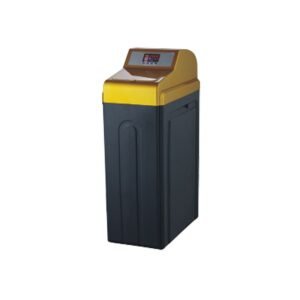
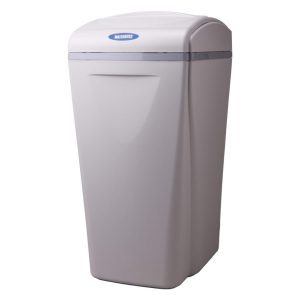
An extremely compact water softener that fits even in apartment cabinets or under the sink.
Hard water enters the softener, where ion exchange takes place: the calcium and magnesium ions that cause hardness are bound in the ion exchange resin and replaced with sodium ions, which dissolve well in water.
Water flow is controlled by a control valve programmed for your water quality. When the ion absorption capacity is exhausted, the unit automatically regenerates the resin tank (dissolved salt for regeneration is in the brine tank). Regeneration restores the system’s capacity.
WATER HARDNESS UNIT CONVERSION
Water hardness is an indicator measured in specific units, usually showing the amount of Ca and Mg salts dissolved in water. It is expressed in mmol/l (millimoles per litre) or mg/l (milligrams per litre, CaCO3 equivalent).
Hardness levels
soft – 0–20 mg/l
fairly soft 20–40 mg/l
slightly hard 40–60 mg/l
fairly hard 60–80 mg/l
hard 80–120 mg/l
very hard >120 mg/l
As water hardness can also be measured in other units, you can use the table below to convert between units.

WATER SOFTENING
More than 60% of the Earth’s water is groundwater, which picks up a variety of minerals from the soil as it seeps down, including calcium and magnesium. The amount of these hardness minerals determines the water’s “hardness”. Water hardness is measured by the amount of dissolved Ca and Mg salts – mg-eq/l. Limit CaCO3 values: soft water 0–1 mg-eq/l, very hard water >6 mg-eq/l.
Excess calcium and magnesium salts cause limescale deposits, white spots on sinks and baths, and very weak flow from showers and taps due to scaling. Water softening helps reduce the concentration of calcium and magnesium ions in water.
Households most often use softening filters consisting of a filter vessel filled with synthetic resin, called cation exchange media, and a salt tank. Hard water is filtered through the resin, which retains the hardness minerals in the water in a so-called ion exchange reaction, in which calcium and magnesium ions are replaced by sodium ions. After a while the resin becomes saturated and must be renewed, as its exchange capacity is exhausted. This is done by the regeneration programme – the resin is regenerated with a common salt solution.
Regeneration consists of several cycles in which a special brine and water, flowing in different directions and at different speeds, rinse the media, and the accumulated hardness ions are flushed to the drain. Filters use special NaCl salt for regeneration, so the salt tank needs topping up from time to time.
Many people think that water from a softener cannot be drunk because it contains too much sodium. However, the average sodium content per litre of softened water is 60 to 90 mg, while a slice of white bread contains 120 mg of sodium.
If this sodium is undesirable, you can additionally install reverse osmosis drinking water filters, which remove all the sodium from the water.
BENEFITS OF WATER SOFTENING
Soft water protects pipes and heating elements from limescale deposits, which increase energy consumption when heating water.
Helps protect taps from limescale so they shine like new.
Your household appliances, such as washing machines, boilers, dishwashers, etc., will last longer and need fewer descaling products.
A great feeling in the bath and shower. Soft water is ideal for sensitive skin. Spend less on skin care products and moisturisers.
Protect your glassware and tableware from limescale and save money by using fewer chemical descaling products.
Your clothes will be cleaner and more vivid, and fabrics will be softer. Save on soap and fabric softener.
CONNECTION PARAMETERS
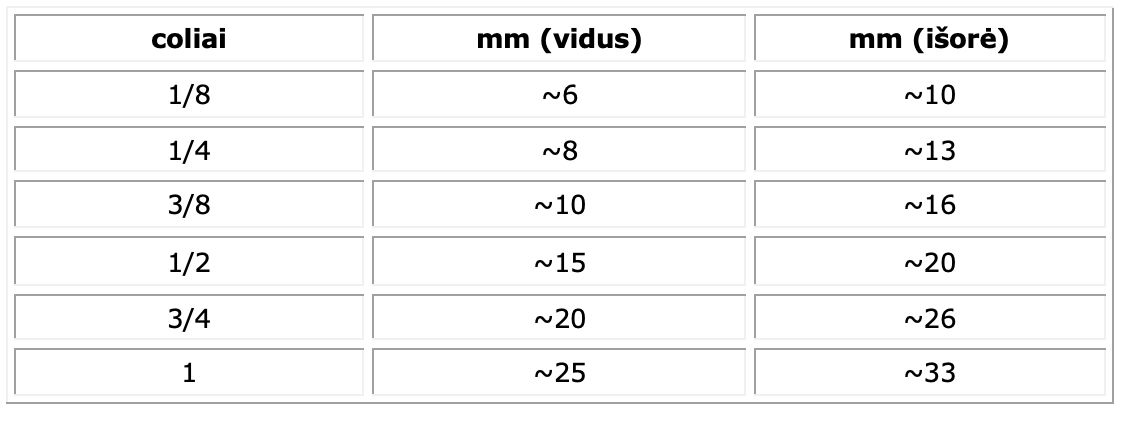
Connection sizes are usually given in inches, which causes confusion about which fittings to choose, as we are used to metric units – in this case millimetres. The ratio of inches to millimetres for fittings is roughly as follows; measuring with a caliper is recommended: